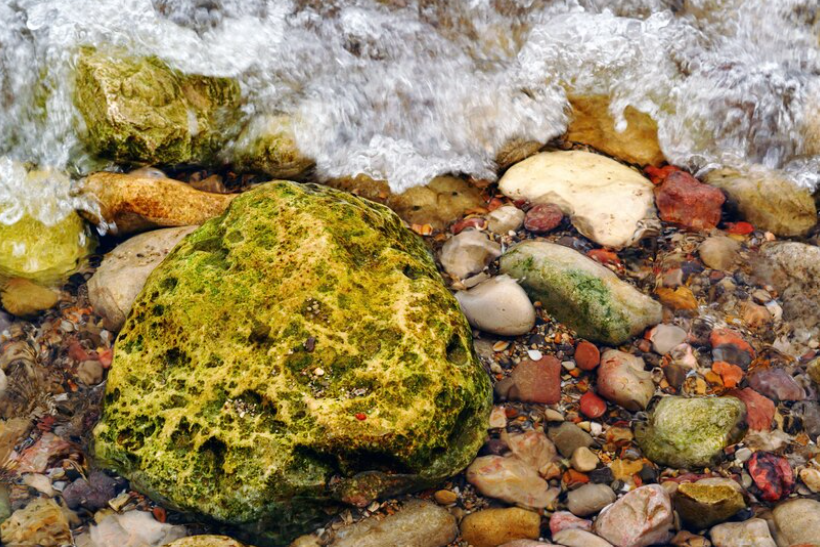
Sea moss that has been wildcrafted is gathered from beaches and shorelines where it grows naturally.
Usually, the procedure entails chopping or eliminating the sea moss out of the implanted spot.
This is the growth pattern of several seaweeds, which are all a component of the environment in which they are found.
Some individuals are more careful than others when it comes to wildcrafted sea moss and other seaweeds that are wildcrafted; they just chop the plant slightly off where it grows onto the stone or substrate.
Some people don’t care as much about the environmental effects and pull seaweed out of any place they find it.
In any case, we oppose wildcrafting because it harms the ecosystem.
You’re not contributing anything back, even if you take care while cutting the sand off the rock or gather it ashore off the shore if it’s washed up.
Additionally, when you purchase wildcrafted goods, you are not contributing in any way.
We think that protecting the marine environment and our planet is more essential than planting more sea moss or similar seaweeds for collection when it is practical and sustainable to do so.
Please bear with me as I briefly explain my reasoning on this.
But I believed that wildcrafted real sea moss was required.
While I believe wildcrafting is a lovely notion, how many individuals do you think frequently purchase sea moss?
Considering this query from a business perspective presents a small obstacle. What are the implications of this, both directly and indirectly?
Consider the island of St. Lucia, where research has revealed that certain portions of its shorelines are shielded by weak coral reefs.
In a situation like this, wildcrafting puts further strain on the already tenuous balance.
The 1,462 square kilometers of sea grasslands (the ecosystems including those in which sea moss grows) that were evaluated in the Caribbean in 2010 are predicted to shrink to as little as 155 square kilometers by 2025 if suitable measures are not put in place if development along the coast is not controlled.
That is an astounding 89.39% decrease in the area of the seagrass ecosystem.
As you can see, there is at least reason for thought and conversation when it comes to the subject of wildcrafting.
The growth of the coastlines that these often grow along is another issue that the oceans are fighting in addition to the removal of sea moss for human consumption.
It’s not that big of a thing, your little bag of sea moss, is it?
I would urge you to reconsider. There are an astounding 7.7 billion individuals on the earth, of which you are just one.
It’s not a huge concern, as hardly every one of the 7.7 billion individuals worldwide use sea moss, is it?
Pretend that 0.01% of people on the planet frequently eat sea moss. That is 770,000 individuals.
Still seems like a lot, doesn’t it? That is just 23,000 more persons than the whole population of Guyana.
What substitute is available for wildcrafted sea moss?
We all must strive to promote the responsible husbandry of our oceans. Unsustainable businesses won’t close their doors until they are no longer receiving your money.
This has nothing to do with going to battle with any company or closing down unprofitable operations in bulk. It is a more sustained campaign of persuasion to implement eco-friendly adjustments.
We want the present sea moss companies to alter their operations. It’s acceptable that you have a supplier that you like. It is up to you to determine whether or not to keep supporting them if they aren’t acting in the best interests of the planet.
How can the Wildcrafting Sea Moss be changed?
Rather than engaging in commercial wildcrafting, companies that sell sea moss should consider using sustainable open-ocean farming methods. Here, the word “responsible” is emphasized.
Future food supplies that benefit future populations and our planet might come from ocean viticulture.
Open ocean farming techniques still present certain difficulties, but as we try more approaches, we get better at it. It is these kinds of efforts that we try to encourage and raise awareness of.
We believe that the most important factor to take into account while farming seaweed in the open ocean is that the species being farmed cannot pose a danger to the environment.
Even while increasing the amount of seaweed in the ocean is preferable to wildcrafting, introducing an aquatic noxious weed can do more damage than good. Professor Craig R. Johnson’s 2008 book Seaweed Invasions:
An Overview of Ecological, Economic, and Legal Imperatives provides a concise presentation of numerous incidents.
The query “What is wildcrafted sea moss?”. This has more dynamic components that should be given careful thought.
especially over the idyllic notion of your sea moss growing naturally on a spotless beach. That alone, in my opinion, is sufficient proof that using wildcraft for profit is wrong.
What distinguishes wildcrafted sea moss from Irish sea moss?
The red algae or seaweed known as Irish Sea Moss, or Chondrus crispus, is found growing on the rocky shores along the Northern Atlantic.
It is well-known for having a high nutrient profile, including minerals and vitamins, and health advantages like supporting gastrointestinal health, improving thyroid function, helping with weight control, and promoting the growth of collagen and muscle.
Wildcrafted sea moss is taken straight from the ocean, where it has not been artificially cultivated or farmed. Because it guarantees the sea moss maintains its original nutrient profile, this technique is frequently valued.
What negative impacts may wildcrafted sea moss have?
The negative consequences of sea moss, particularly sea moss that has been wildcrafted, can differ based on a person’s health and the quantity ingested.
Because of its iodine concentration, it is imperative to take into account possible interactions with drugs or medical conditions, particularly those about the thyroid.
To whom not to give sea moss?
People who are taking sea moss and have certain medical conditions ought to be cautious or stay away from it.
Because of its high iodine concentration, which might alter thyroid function, this also applies to people who have hyperthyroidism.
Individuals who are allergic to shellfish or iodine may also encounter negative outcomes. Additionally, to prevent any potential problems, people taking certain medications—particularly those for thyroid disorders—should speak with a healthcare provider before adding sea moss to their diet.
It is advised to speak with a healthcare professional for comprehensive advice.
In summary
We have discussed the environmental effects of sea moss harvesting sustainably and the importance of doing so in our investigation of the wild variety.
We promote responsible choices because we are genuinely committed to the health of the world and sustainable activities.
Check this Article Also: How Snokido is Revolutionizing the Online Gaming Industry