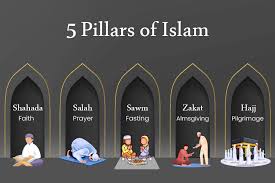
Islam has a practical approach to life and provides a complete and thorough code of conduct. Give a detailed set of rules and guidelines to build the entire infrastructure of a Muslim community and the five pillars of Islam faith serve as the foundation. These are Muslim basic obligations towards their faith. They are Islam’s core; it is crucial to understand their true essence and meaning.
What you can learn in Five Pillars of Islam Course?
- Shahadah
- Salah
- Zakat
- Sawm
- Hajj
Let’s learn about them to understand their meaning and impact on individuals and society.
- Shahadah
The first pillar of Islam is the declaration in Arabic that “There is no God but Allah and Muhammad (PBUH) is the messenger of Allah”.
But Shahadah is not just saying those words but also understanding and accepting what it means with free will. The intent is the most important in Islam so shahadah should be taken with intent.
Let’s see what Shahadah means
- There is no God but Allah.
- Hazra Muhammad (PBUH) is the messenger of Allah to guide humankind.
2. Salah
2nd pillar of Islam. They are obligatory daily prayers, five times a day at a set time. The order of the prayer is
- Fajr
- Zuhr
- Asr
- Maghrib
- Isha
The requirements for offering prayer are
∙ Offer at the set time
∙ Cleanliness of clothes and body
∙ Wudhu (ablution. Purifying one physical self for prayer)
Muslims are encouraged to offer prayer in mosques, providing an opportunity to meet others, building a sense of community, and supporting network. They meet there and discuss different aspects of life and society, exchange views and share ideas.
3. Zakat
3rd pillar of Islam is Zakat. Zakat is an obligatory charity; every year Muslims pay 2.5% of their held wealth over a certain threshold to the less fortunate. The wealth can be in the form of cash, property, silver, gold, and animals. Zakat is believed to “purify” or “cleanse” wealth.
Nisab i.e. minimum wealth a Muslim should possess to be eligible to pay Zakat i.e. 7.5 tolas (87.48 grams) of Gold and 52.5 tolas (612.36 grams) of silver.
Nisab For Animals:
30 Cattle
40 goats & sheep
5 camels
Nisab For crops called usher is five wasqs i.e. the minimum amount of yield. The Zakat is
1/10 of the yield if the land is naturally irrigated.
Half of 1/10 of the yield if the land is artificially irrigated.
Zakhah donated to those in need, creating great qualities of sacrifice and brotherhood among Muslims.
4. Sawm
4th pillar of Islam is Sawm: fasting in the month of Ramadan from dawn to sunset. Muslims don’t eat and drink during that time but it’s not limited to just that. It’s to cultivate a sense of discipline and abstinence from bad habits and temptations in Muslims. It also generates empathy in Muslims to understand the pain of others by going through them.
There are two meals that Muslims eat in Ramadan i.e.
Suhoor – pre-dawn meal, eaten before beginning the fast.
Iftar – the meal is eaten at the time of breaking the fast i.e. after sunset.
The purpose of Sawm is taqwa i.e. fear of Allah and generates empathy in Muslims.
5. Hajj
The last and 5th pillar of Islam is Hajj or the pilgrimage to Mecca in the month of Dhul Hijjah. Muslims from all around the world congregate in Mecca to worship Allah and perform certain rituals in plain white clothes. Every Muslim must at least once offer Hajj in their lifetime.
The Hajj promotes unity among Muslims. The Hajj is the practical demonstration that in front of Allah, everyone is equal and there is no distinction based on color, race, wealth, etc.
Every Muslim whether kids, adults, men, or women should learn about the pillars of Islam. Busy life and lack of institutions get in the way of learning about Islam. But thanks to modern technology, online academies make it possible to learn about the five pillars of Islam at any time and from anywhere. They provide quality education with flexibility and convenience.
Al-Quran like many others provides online classes on the five pillars of Islam faith.
Conclusion
The five pillars of Islam faith are the backbone of Islam. The essence of them is sacrifice and submission. In-depth learning is instrumental in strengthening the faith in Muslims. Practicing them helps us get close to Allah and care for other human beings by empathizing with them. To be a better Muslim, we should practice the five pillars of Islam and understand their meaning and motives.