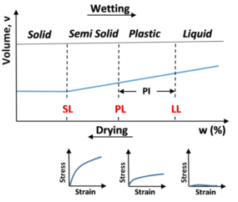
Soil classification is fundamental in various engineering disciplines, including construction, geotechnical engineering, and environmental science. Among the myriad of parameters used in soil classification, liquid limit stands out as a critical indicator of soil behavior. This guide aims to provide a comprehensive overview of liquid limit, its role in soil classification systems, testing methodologies, influencing factors, and practical implications in engineering practices.
Understanding Liquid Limit:
Liquid limit refers to the moisture content at which a soil transitions from a plastic to a liquid state under specific standardized conditions. It is determined through laboratory testing using standardized methods such as the Casagrande method or the cone penetrometer method. At the liquid limit soil, the soil exhibits minimal shear strength and flows like a viscous fluid.
Significance of Liquid Limit in Soil Classification:
Liquid limit plays a pivotal role in soil classification systems, such as the Unified Soil Classification System (USCS) and the American Association of State Highway and Transportation Officials (AASHTO) classification. It aids in categorizing soils into distinct groups based on their behavior and engineering properties, facilitating informed decision-making in various construction projects.
Liquid Limit Testing Methods:
Several methods are employed to determine the liquid limit of soils, including the Casagrande method, which involves repeatedly striking a soil sample in a standardized cup until it reaches its liquid state. Another commonly used method is the cone penetrometer method, where a cone penetrates the soil at a standardized rate until it reaches a specified depth.
Factors Affecting Liquid Limit:
Various factors influence the liquid limit of soils, including mineral composition, particle size distribution, organic content, and environmental conditions such as temperature and humidity. Understanding these factors is essential for accurate interpretation of liquid limit test results and predicting soil behavior.
Implications of Liquid Limit in Engineering:
The liquid limit of soils has significant implications in geotechnical engineering, construction, and infrastructure development. It influences crucial aspects such as soil compaction, slope stability, foundation design, and pavement construction. Engineers rely on liquid limit data to assess the suitability of soils for specific applications and mitigate potential risks associated with soil instability.
Conclusion:
In conclusion, liquid limit serves as a fundamental parameter in soil classification systems and holds immense importance in various engineering applications. Its accurate determination and interpretation are vital for informed decision-making and ensuring the stability and performance of infrastructure projects. As a leading provider of materials testing equipment, certifiedmtp.com offers a comprehensive range of tools and solutions to support accurate and reliable soil testing, including liquid limit analysis. Our commitment to quality and customer satisfaction makes us a trusted partner for engineering professionals seeking precision and efficiency in their soil testing endeavors.
FAQs (Frequently Asked Questions):
What is liquid limit in soil testing?
Liquid limit refers to the moisture content at which a soil transitions from a plastic to a liquid state under standardized conditions. It is a crucial parameter in soil classification and engineering practices.
How is liquid limit determined?
Liquid limit is determined through laboratory testing using standardized methods such as the Casagrande method or the cone penetrometer method. These methods involve subjecting a soil sample to controlled conditions and observing its behavior as moisture content increases.
Why is liquid limit important in soil classification?
Liquid limit helps classify soils into distinct groups based on their behavior and engineering properties. It provides valuable insights into soil consistency, shear strength, and potential for deformation, aiding in project planning and risk assessment.
What factors affect the liquid limit of soils?
Several factors influence the liquid limit of soils, including mineral composition, particle size distribution, organic content, and environmental conditions such as temperature and humidity. Understanding these factors is essential for accurate interpretation of liquid limit test results.
How does liquid limit impact engineering practices?
The liquid limit of soils has significant implications in geotechnical engineering, construction, and infrastructure development. It influences soil compaction, slope stability, foundation design, and pavement construction, guiding engineering decisions and ensuring project success.


