Monroe's Motivated Sequence
Dialogue and effective communication underpin much of society’s success in influencing behavior and change. Whether it’s a rousing political speech, a product launch presentation, or a lesson plan in a classroom, persuading an audience is an invaluable skill. Monroe’s Motivated Sequence (MMS) is a time-tested method for achieving persuasive success. Developed by Alan H. Monroe in the 1930s, the Sequence offers a structured approach to capturing and holding an audience’s attention through a series of logical steps leading to a call to action.
In this comprehensive discourse, we’ll unravel the power of Monroe’s Motivated Sequence, understand its five critical phases, and explore its potent applications in public speaking, marketing, and education.
What is Monroe’s Motivated Sequence (MMS)?
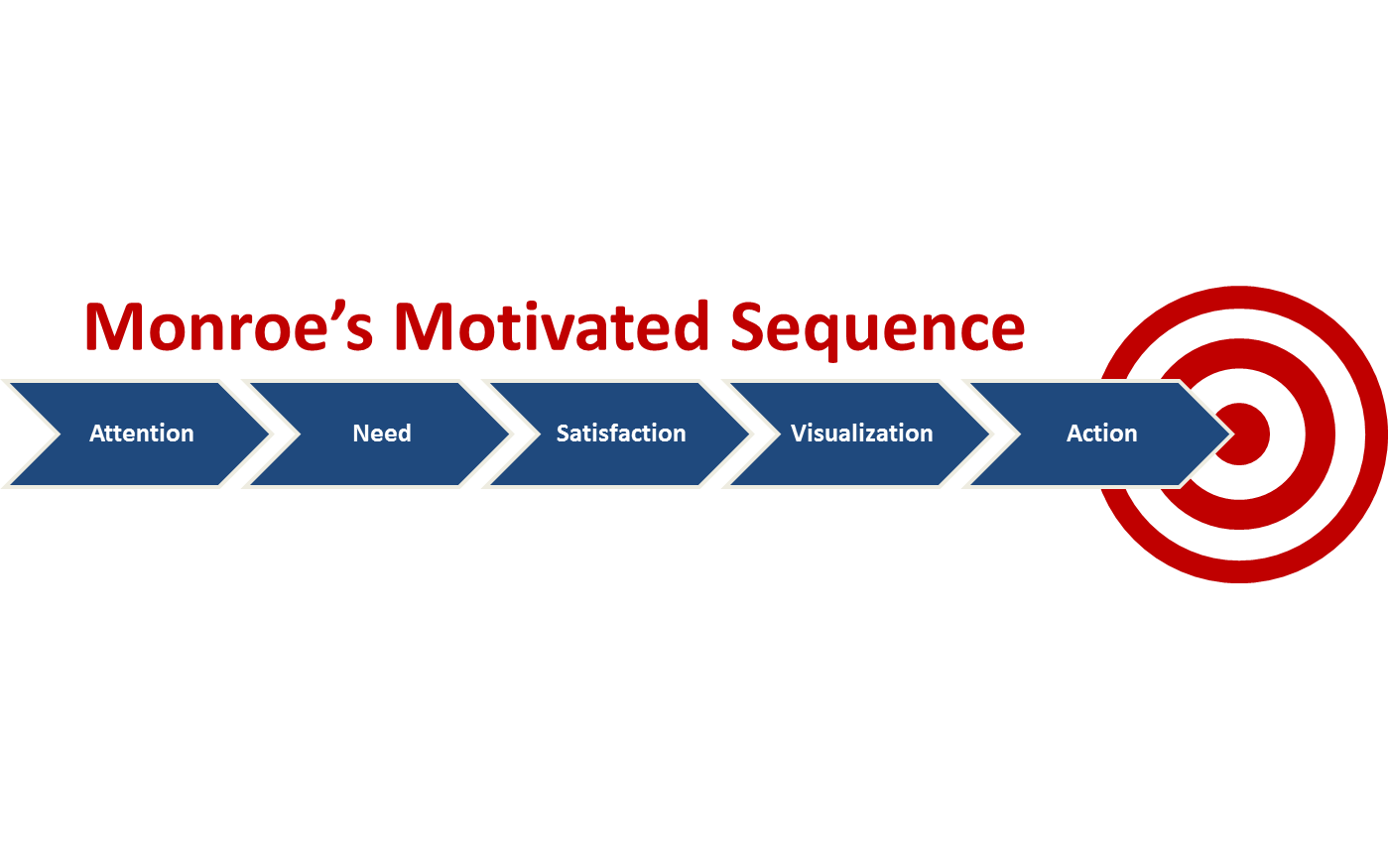
Monroe’s Motivated Sequence is a five-step pattern designed to grab an audience’s attention, make them aware of a particular problem or need, offer a solution that satisfies this need, help them visualize the benefits of the solution, and finally, move them to accept and act on the advocated solution. The Sequence is logical and taps into the emotional motivations that guide human decision-making.
The Five Steps of MMS
Monroe’s Sequence involves five strategic steps:
- Attention – The opening step includes a hook to engage the audience.
- Need – The presenter identifies a problem or need, creating a sense of urgency.
- Satisfaction – A solution that meets the identified need is presented.
- Visualization – The audience is guided to visualize the outcome and benefits of the proposed solution.
- Call to Action – The presentation culminates with a persuasive call to action, urging the audience to act on the solution.
These stages guide speakers and message creators to build a narrative that captures the audience’s imagination and reason, compelling them to adopt the speaker’s point of view.
Real-World Applications of MMS
Understanding MMS can transform how we communicate in various settings. Let’s take a closer look at how MMS is applicable in real-world scenarios:
In Public Speaking
Public speaking is an arena where MMS shines, particularly when the message is meant to be persuasive. A politician, for instance, can use this strategy to take voters on a journey from listening to urgent issues, considering potential solutions, imagining a better future, and finally, asking for a vote.
In Marketing
Marketing campaigns often adopt a modified version of MMS to persuade customers. Advertisers begin with an attention-grabbing commercial, move on to highlight a problem their product can solve, present the product as the solution, encourage the viewer to imagine the product improving their life, and finally, send a clear call to action (CTA).
In Education
Educators utilize MMS to engage students and convey complex ideas effectively. The Sequence helps rationalize thought processes and guide conversation, which is highly beneficial in teaching persuasive writing and oratory skills.
How to Encode MMS into Your Presentations?
Adopting MMS into your presentations can be a game-changer in how your audience perceives and acts upon your message. Here’s how to structure your speech or presentation to align with MMS:
Crafting the Opening Hook
Capture your audience’s attention in the first few seconds with a powerful quote, a compelling story, a surprising fact, or an engaging question. The key is to create an initial memorable moment that will serve as a bridge to the needed step of MMS.
Identifying and Presenting the Need
Clearly articulate the need or problem your audience faces. This could be a need for more awareness, a challenge, or an unmet need. Use data and statistics to solidify your claims and evoke a sense of significance and urgency.
Presenting a Satisfying Solution
Here, you offer a solution tailored to the identified need. This step should resolve the need and outshine other possible solutions, thereby establishing your proposal as the best course of action.
Visualization for a Memorable Impact
With the need addressed, help your audience visualize your solution’s positive effects and outcomes. Use vivid language, storytelling, and relatable scenarios to paint a picture of success post-action.
Crafting a Resounding Call to Action
A persuasive call to action is more than just asking an audience to do something. It should be clear, actionable, and compelling. Also, your audience should be equipped with the tools or guidance necessary to follow through on the action.
Case Studies and Success Stories with MMS
Learning from real-world applications can illuminate the impact and adaptability of MMS. Consider the success stories of notable leaders and marketers who mastered Monroe’s Sequence to achieve their objectives.
Political Oratory
Many influential political leaders have utilized MMS, one being Martin Luther King Jr.’s “I Have a Dream” speech. King powerfully articulated the need for equality and justice, offered the vision of a harmonious society, and beckoned the crowd to take the necessary action to make that dream a reality.
Marketing Campaign Success
A classic application of MMS in marketing occurred during the 1984 launch of the original Apple Macintosh. The attention fell on a provocative advertisement, highlighting the need to think differently, offering Macintosh a unique and satisfying solution, and ultimately visualizing a world transformed by this product.
The Role of MMS in Today’s Communication Landscape
In a digitally saturated world, the attention span is short, and the marketplace of ideas is crowded. Monroe’s Sequence is more relevant than ever, providing a clear framework to cut through the noise and deliver a persuasive message.
Adapting MMS to modern communication channels, such as social media, email marketing, and video platforms, allows for brief yet powerful storytelling that resonates with the audience and leads to measurable results.
Crafting a Persuasive Call to Action with MMS
The call to action is the culmination of your persuasive message. It should be noteworthy, specific, and simple for the audience to take the next step. Consider these tips:
- Make the CTA Time-Bound and Urgent: Phrases like “Act now” or “Don’t miss out” can add a sense of immediacy that prompts action.
- Use Persuasive Language: Your words can significantly influence the audience’s decision. Play on emotion and logic to create a compelling CTA.
- Provide Clear Instructions: Eliminate ambiguity from your CTA. Users should know exactly what they need to do to move forward.
Conclusion
Monroe’s Motivated Sequence is a potent tool for public speakers, marketers, and educators who seek to persuade, inspire, and motivate their audiences. It offers a structured yet flexible approach to crafting a message that appeals to listeners’ cognitive and emotional faculties.
By mastering MMS, communicators can achieve their objectives, lead change, and become influential leaders. Remember, the heart of MMS is not just in the Sequence itself but in the depth and authenticity of its message. Master the art of storytelling, and use Monroe’s Sequence to guide your narrative to success.





Абсолютно трендовые новинки индустрии.
Исчерпывающие мероприятия всемирных подуимов.
Модные дома, лейблы, гедонизм.
Лучшее место для модных людей.
https://metamoda.ru/
https://metamoda.ru/
Бренд Balenciaga — это одним из самых известных брендов в мире моды, который появился в начале 20 века легендарным кутюрье Кристобалем Баленсиагой. Бренд известен экстравагантными стилистическими приемами и авангардными кроями, противоречат традиционным представлениям о моде.
https://balenciaga.whitesneaker.ru/